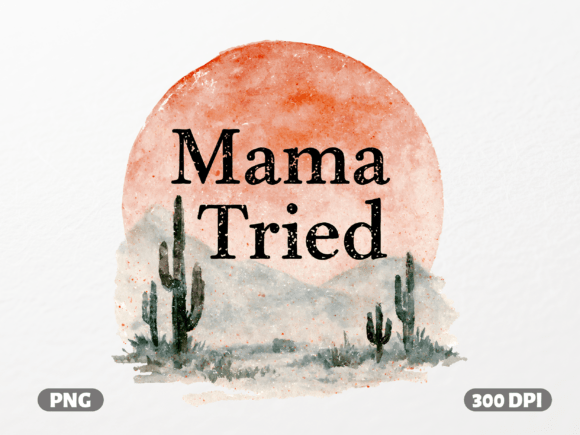
Mama Tried Watercolor Desert: A Designer’s Review
As an embroidery designer who has spent countless hours digitizing and stitching everything from intricate florals to bold typography, I have developed a keen eye for what translates well from screen to fabric. When I first encountered Mama Tried Watercolor Desert, my initial reaction was one of cautious optimism. The concept of blending rustic charm with a soft, artistic watercolor aesthetic is trending heavily in the handmade market right now. However, anyone who has ever tried to replicate a watercolor effect with thread knows the inherent challenges. This review breaks down how this specific graphic performs in real-world applications, offering practical insights for fellow designers, Etsy sellers, and craft entrepreneurs.
First Impressions and Visual Mood
The immediate appeal of Mama Tried Watercolor Desert lies in its atmospheric quality. The design features a hand-painted landscape dominated by saguaro cacti and rolling hills, creating a sense of calm and southwestern nostalgia. For those of us working in T-Shirt Designs and broader Graphics, the composition strikes a balance between detailed illustration and simplified iconography. The mood is warm, inviting, and slightly whimsical, which makes it highly versatile for various demographics. It does not scream for attention; rather, it invites a closer look. This subtlety is crucial for high-end boutique products where understated elegance often sells better than loud, oversized prints.
From a layout perspective, the horizontal spread of the desert scene suggests it is best suited for wider placement areas. The organic shapes of the cacti and hills provide natural flow, avoiding the rigid boxiness that can sometimes plague digital assets. For an embroidery project, this organic flow is a double-edged sword. It looks beautiful, but it requires careful digitizing to ensure the soft edges of the watercolor style do not become jagged or messy when converted into stitches.
Real-World Application: The Custom Tote Bag Test
To truly evaluate a design, you must imagine it on a finished product. I recently considered using Mama Tried Watercolor Desert for a line of custom canvas tote bags intended for a local botanical garden gift shop. This scenario highlights the design's strengths. On a natural, unbleached cotton canvas, the earthy tones of the desert landscape blend seamlessly with the fabric texture. The rustic charm mentioned in the product description becomes tangible here. The design does not fight the material; it complements it.
For an Etsy seller or small shop owner, this versatility is a major selling point. The same design could easily transition from a tote bag to a sweatshirt embroidery project. On a heather grey or sand-colored sweatshirt, the watercolor effect would mimic the softness of the garment itself. However, when moving to smaller items like baby embroidery projects or caps, the complexity of the rolling hills might need simplification. In these cases, the designer must decide whether to reduce the stitch count or enlarge the hoop size to maintain clarity.
Navigating Technical Challenges in Stitching
While the visual appeal is strong, the technical execution of Mama Tried Watercolor Desert requires attention to detail. Watercolor effects rely on gradients and bleeding colors, which are difficult to achieve with standard thread colors. If you are using this as a machine embroidery design, you must pay close attention to stitch density. Too dense, and the fabric will pucker, especially on lighter materials. Too sparse, and you lose the lush, painted look that defines the piece.
I recommend using a combination of fill stitch for the larger areas of the sky and hills, and potentially satin stitch or detailed running stitch work for the outlines of the saguaro cacti. This variation in stitch type adds texture and depth, mimicking the brushstrokes of the original artwork. Before committing to a final production run, always test the design on scrap fabric that matches your final product. Check how the threads interact with the fabric texture. For instance, on a textured towel, fine details may get lost, whereas on a smooth poly-cotton blend, they will pop.
Another critical consideration is the background. Since this is a landscape, negative space is important. If you are stitching on dark fabric, you may need to adjust the thread palette significantly or use an underlay to ensure the colors remain vibrant. Conversely, on light fabrics, the natural translucency of the watercolor style works in your favor. Always create printable mockups in both black and white to check for contrast issues before you even thread the machine.
Where to Use Caution
Not every product is a good fit for this specific graphic. Avoid using Mama Tried Watercolor Desert on very small hoop sizes unless you are willing to sacrifice significant detail. The rolling hills and distant elements may become indistinguishable blobs if scaled down too far. Similarly, be cautious with stretchy fabrics like jersey knits for t-shirts. Without proper stabilizer support, the weight of the embroidery can cause the garment to warp or hang incorrectly. For curved surfaces like baseball caps, the wide horizontal layout might require splitting the design or placing it strictly on the front panel, ensuring it does not wrap awkwardly around the curve.
Enhancing Brand Value and Customer Trust
For creative entrepreneurs, the choice of design assets directly impacts brand perception. Using a high-quality, cohesive graphic like Mama Tried Watercolor Desert signals professionalism. It shows that you care about the artistic integrity of your handmade product. Customers are increasingly savvy; they can tell the difference between a generic clip-art slap-and-print job and a thoughtfully curated design. This particular graphic lends itself well to personalized gifts, such as adding a name in a complementary script font below the desert scene. This customization increases the perceived value and makes the item feel exclusive.
When listing this as a digital embroidery file or selling finished goods, clear photography is key. Show the texture of the stitches. Highlight how the watercolor effect translates into thread. This transparency builds trust and reduces return rates. Whether you are creating holiday embroidery for Christmas gifts or year-round boutique branding, consistency in quality assurance is paramount.
Practical Notes for the Modern Maker
Before you purchase or download any design assets, always verify the licensing terms. Ensure that the file allows for commercial use if you plan to sell finished items. Check the available formats to confirm compatibility with your embroidery machine software. While the visual description promises a beautiful landscape, the technical file quality is what determines your success. Look for clean color stops and logical sequencing in the digitizing.
In summary, Mama Tried Watercolor Desert is a compelling choice for designers looking to add a touch of southwestern warmth to their collections. It excels in medium-to-large format applications like tote bags, aprons, and sweatshirts. With careful attention to stabilizer choice, thread selection, and fabric compatibility, it can elevate a simple garment into a cherished keepsake. For the serious craft business owner, this design offers the perfect blend of artistic flair and commercial viability, provided it is executed with the precision it deserves.